
Section 1 of EMI's Creation Care Whitepaper
1.1 Human Impacts on a Changing World
One commonly used approach for describing patterns of environmental change is the planetary boundaries framework, first developed in 2009 by the international scientific community. Their work identifies nine critical earth-system processes and associated boundaries within which humanity is able to thrive and flourish. The framework continues to evolve through updates informed by current scientific understanding and serves as a resource for governance strategies and policies at all levels, including the UN Sustainable Development Goals. Like all scientific models, this framework represents an evolving human attempt to describe complex systems within God’s creation, and should be understood as a tool for observation rather than a definitive or prescriptive authority.
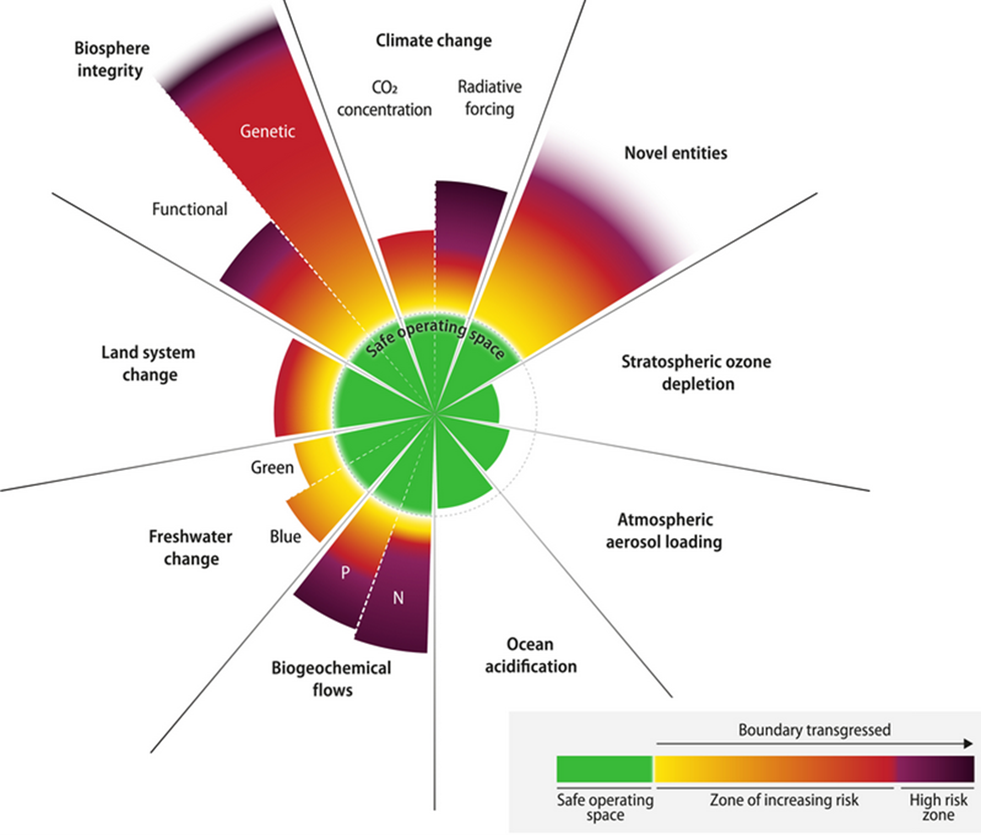
Fig 01. - The current status of nine earth-system processes, as of 2023. (Richardson, 2023, Fig.1)
Rather than isolating and independently addressing the changes within specific processes, planetary boundaries are meant to be considered together as interconnected systems, especially when studying the overlapping influences of human (anthropogenic) activities. The observable changes in these integrated processes over recent history, generally within the last 50-100 years, are briefly described below along with a description of each earth-system.
Biosphere Integrity
Biosphere Integrity refers to the loss of biodiversity and ecosystem function caused by human activity. It includes both genetic diversity (variation within species) and functional diversity (the roles species play), which are important for maintaining the earth's resilience and stability. Since 1970, habitat destruction, pollution, and overexploitation have driven a 73% average decline in wildlife populations across marine, freshwater, and terrestrial ecosystems (WWF Living Planet Report, 2024). The IPBES Global Assessment Report has observed that within approximately 8 million known species of animals and plants, around 1 million are currently threatened with extinction (IPBES, 2019).
Climate Change
Earth’s climate is shaped by the balance of solar energy absorbed and radiated back into space. While climate naturally varies due to seasonal cycles, ocean patterns, and volcanic activity, recent warming has been largely attributed to rising levels of greenhouse gases like CO₂, methane, and nitrous oxide. These gases trap heat, intensifying the greenhouse effect (Boorse, 2022). Global average temperatures have risen by about 1.2°C above pre-industrial levels, with most of that warming occurring in the past 50 years. This has accelerated the intensity of weather events, ice melt, and sea level rise, contributing to complex feedback patterns within the climate system that scientists continue to study and seek to understand.
Novel Entities
Novel entities refer to human-made substances—like synthetic chemicals, plastics, heavy metals, and genetically modified organisms—that do not naturally occur and can disrupt earth’s systems. This boundary is exceeded when their production and release outpace our ability to assess and manage their risks to ecosystems and human health, i.e. before testing can occur. Since the 1970s, over 350,000 synthetic chemicals have been registered globally. In this same time period, 3.1 billion metric tons of plastics have also accumulated, with around 140 million metric tons distributed in rivers, lakes, and oceans (Statista, 2024).
Stratospheric Ozone Depletion
This boundary addresses ozone layer thinning caused by human-made chemicals like CFCs, which reduce its ability to block harmful UV radiation. Since the 1980s, significant ozone loss—especially over Antarctica—has largely stabilized due to globally-agreed regulatory action. If current policies continue, full recovery is expected by mid-century.
Freshwater Change
Freshwater use describes the safe limits of water consumption and changes to the global hydrological cycle, encompassing both blue water (surface and groundwater) and green water (soil moisture available to plants). Growing populations, intensive agricultural use and economic shifts towards more resource consuming patterns have led to a rise in consumption of nearly 1% per year since the 1980’s. Current annual withdrawals of more than 4 trillion m3 have led to widespread river depletion, groundwater overextraction, and declining water quality (UNESCO, 2024). Despite increasing levels of use, according to the UN World Water development report, roughly half of the world’s population still experiences severe water scarcity for at least part of each year.
Atmospheric Aerosol Loading
This type of loading refers to the concentration of tiny particles (such as sulfate, black carbon, and dust) in the atmosphere that influence climate by affecting cloud formation, precipitation, and the earth’s radiation balance, as well as impacting human health. Currently an est. 2.8 billion people are exposed to hazardous levels of air pollution worldwide (Health Effects Institute, 2024). Over the past 50 years, industrial emissions, biomass burning, and urban pollution have raised aerosol concentrations, especially in Asia and Africa, altering monsoon patterns and regional climates. In contrast, other areas of the world have seen modest improvements due to air quality regulations.
Ocean Acidification
Ocean acidification is the ongoing decrease in ocean pH caused by the absorption of excess atmospheric CO₂, which disrupts marine ecosystems and weakens the ability of organisms like corals and shellfish to build calcium carbonate shells and skeletons. Since the start of the Industrial Revolution, ocean surface pH has dropped by about 0.1 units (a 30% increase in acidity), placing increasing stress on marine ecosystems that support biodiversity and food systems. (National Oceanic and Atmospheric Administration, 2020).
Land System Change
Land-system change refers to the large-scale conversion of natural ecosystems—like forests, grasslands, and wetlands—into agricultural, urban, or industrial areas. This reduces biodiversity and disrupts key earth-system processes. Deforestation across tropical, temperate, and boreal forest biomes have diminished carbon storage and altered water and nutrient cycles. Although deforestation rates are slowing, over 460 million hectares of tree cover have been removed in the past 25 years—a 12% decline since 2000. (Global Forest Watch, 2024).
Biogeochemical Flows
Biogeochemical flows refer to global cycles of key elements like nitrogen and phosphorus, which support ecosystem productivity and water quality. Excessive fertilizer use, industrial agriculture, and increasing wastewater discharge have accelerated these flows, causing eutrophication—nutrient overloads that lead to dense plant growth and oxygen-depleted waters.
Together these stresses invite thoughtful reflection on how humanity interacts with the earth’s natural systems and how we might respond with greater humility, wisdom, and care.
Unifying Statement:
Rooted in our biblical calling to steward God’s creation, we seek to thoughtfully engage the observable symptoms and felt effects of a ‘groaning creation’. These realities help us discern how to live out faithful obedience as designers of the built environment in ways that reflect the gospel and honour the Creator.
1.2 Those most affected from a changing environment
The symptoms of a groaning creation are not equally felt, with communities and nations least responsible for its causes sometimes experiencing its most severe effects. People living in poverty face greater risks, with environmental degradation compounding their existing vulnerabilities in several key areas:
- Increased Vulnerability to Climate and Environmental Shocks
People in resource-constrained communities are often more vulnerable to environmental hazards and disruptions, such as droughts, floods, and heatwaves, due to living in more risk-prone areas combined with inadequate housing and infrastructure. They often lack access to early warning systems or emergency support, making initial responses and recovery more difficult. As a result of limited risk protection, they are more frequently displaced. - Dependence on Natural Resources for Survival
Many low-income communities depend directly on farming, fishing, and local ecosystems for food, water, and income. Environmental degradation—such as soil depletion, water scarcity, or loss of biodiversity—directly threatens their basic needs and economic stability. Lack of access to affordable energy often creates compounding issues, e.g. cooking with inefficient firewood can lead to deforestation and health problems from smoke inhalation (aerosol loading). - Limited Capacity to Adapt and Recover
With less access to financial resources, education, or government support, people with resource constraints have fewer coping mechanisms to adapt to environmental changes or recover from disasters. Sustainable technologies and innovations are often unaffordable or unavailable in lower income settings. This lack of adaptive capacity reinforces cycles of poverty and deepens inequality, highlighting the need for compassionate, thoughtful stewardship.
Researchers studying families impacted by poverty in 16 low-income nations have found a strong correlation between increased vulnerability and changes in the environment (Ahmed, et.al. 2009). Many of these families represent the beneficiaries of EMI’s projects. In the following section we’ll discuss how these changes directly intersect with our approach to serving communities and the church through the built environment.
Unifying Statement:
Faithful stewardship includes caring for those who are most vulnerable to environmental stress and disruption. In serving communities with fewer resources, EMI reflects God's justice and compassion by designing the built environment to provide protection, dignity, and care for both people and the places they depend on.
Works Cited:
Ahmed, S. A., Diffenbaugh, N. S., & Hertel, T. W. (2009). Climate volatility deepens poverty vulnerability in developing countries. Environmental Research Letters, 4(3), 034004. https://doi.org/10.1088/1748-9326/4/3/034004
Boorse, D. (2022) Loving the Least of These, addressing a changing environment, National Association of Evangelicals, https://www.nae.org/wpcontent/uploads/2022/08/LovingTheLeastOfThese_0822_FINAL_Pages.pdf
Global Forest Watch. (2024). Vital forest statistics: Tree cover loss 2001–2022 [Data summary]. World Resources Institute. https://www.globalforestwatch.org/
Health Effects Institute. (2024). State of Global Air2024 [Special report]. Health Effects Institute. https://www.stateofglobalair.org/reports/state-global-air-report-2024
Intergovernmental Science-Policy Platform on Biodiversity and Ecosystem Services. (2019) Global Assessment Report on Biodiversity and Ecosystem Services: Summary for Policymakers. IPBES Secretariat. https://ipbes.net/global-assessment.
National Oceanic and Atmospheric Administration. (2020). Ocean acidification. U.S. Department of Commerce. https://oceanacidification.noaa.gov/
Otto, I. M., & Schleifer, P. (2020). The global political economy of the environment. Cambridge University Press.
Richardson, K. et al., (2023) Earth beyond six of nine planetary boundaries. Science Advances, 9[37]:eadh2458, https://pubmed.ncbi.nlm.nih.gov/37703365/
Statista. (2024) Global Plastic Production 1950-2023. Statista Research Department. https://www.statista.com/topics/5266/plastics-industry/?utm_source=chatgpt.com
UNESCO. (2024). United Nations world water development report 2024: Water for prosperity and peace. UNESCO. https://www.unesco.org/reports/wwdr/en/2024/s
WWF (2024) Living Planet Report 2024 – A System in Peril, World Wide Fund for Nature, https://livingplanet.panda.org/en-US/living-planet-report-2024-key messages/?utm_source=chatgpt.com
Warners, D.P., Ryskamp, M., & Van Dragt, R. (2014, December). Reconciliation ecology: A new paradigm for advancing creation care. Perspectives on Science and Christian Faith, 66(4), 221–235
Download the Full Whitepaper:
Related articles


Your investment in EMI is a catalyst for change.
Community transformation starts with design. And design needs a strong foundation. Your donation to the EMI Fund supports everything we do.
EMI Tech is looking for contributors – write to publications@emiworld.org with your topic and article outline.