
Section 4 of EMI's Creation Care Whitepaper
4.1 Sustainable Project Goals
Sustainability within the design and construction industry is often defined as the making of buildings and infrastructure that meet present needs without compromising the ability of future generations to meet their own needs. More specifically, this definition typically promotes a balance of sustainability across social, environmental and economic dimensions.
An EMI response deepens that vision within a restorative mission— adding a theological and relational dimension to our activities within the built environment. One method for practically defining sustainability and the nature of these activities is through EMI’s core value of Design.
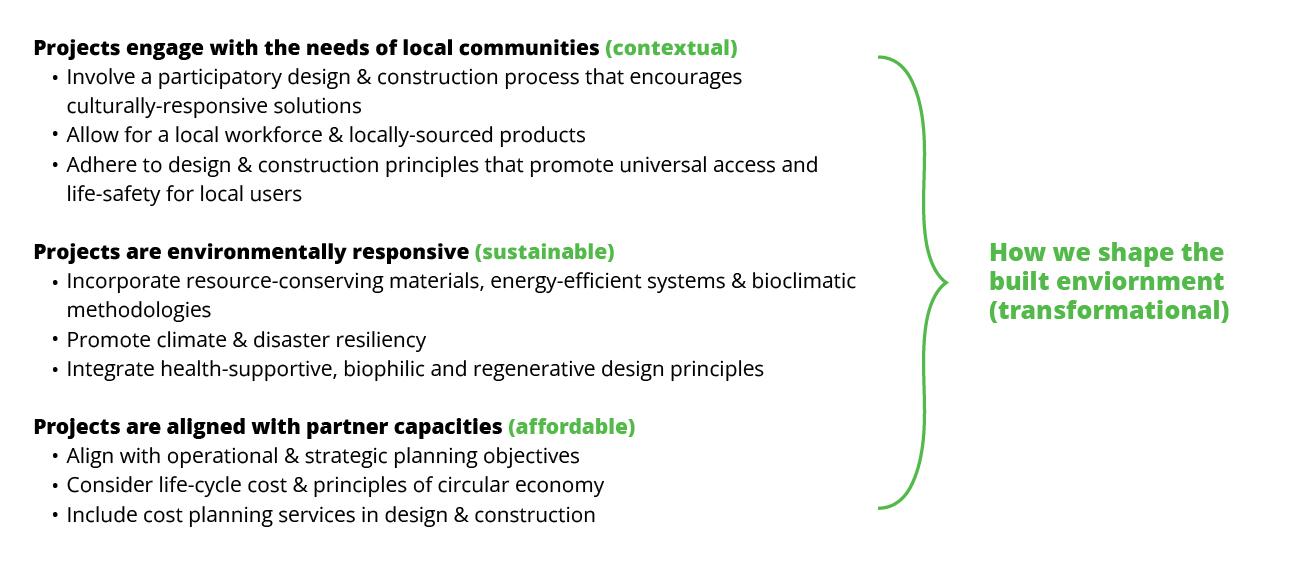
Design: EMI works within the local context to design and construct culturally appropriate facilities that are sustainable, affordable, and transformational.
The expression of this narrative begins to holistically define a sustainable approach to projects across three related dimensions:
Unifying Statement:
Sustainability within the context of EMI’s projects, enriched by a vision of restoration, can reflect our core value of Design through locally grounded, environmentally responsive, and practically aligned solutions to promote the flourishing of communities both now and in generations to come.
4.2 Tools and Resources
Implementing sustainable goals across EMI projects requires the development of additional tools, resources and training for project teams. Further defining the factors and sub-factors within each dimension outlined in Section 4.1 may take the form of abbreviated technical guidance with links to localised data and specialised resources.
For example, mainstreaming a Disaster Risk Reduction (DRR) design approach across projects could include a procedural process that helps EMI designers to complete a sequence of steps:
- Analyse a project’s geophysical susceptibility to hazards.
- Map resilience capacity through focus group discussions with project stakeholders.
- Evaluate the site and building(s) from a developed hazard list.
- Develop design solutions/mitigation strategies to address the resilience gaps.
In considering possible formats for assessing a project’s sustainability, EMI’s Creation Care Working Group (CCWG) evaluated a number of established assessment and benchmarking tools, including green building certification programmes and other frameworks for sustainable development.
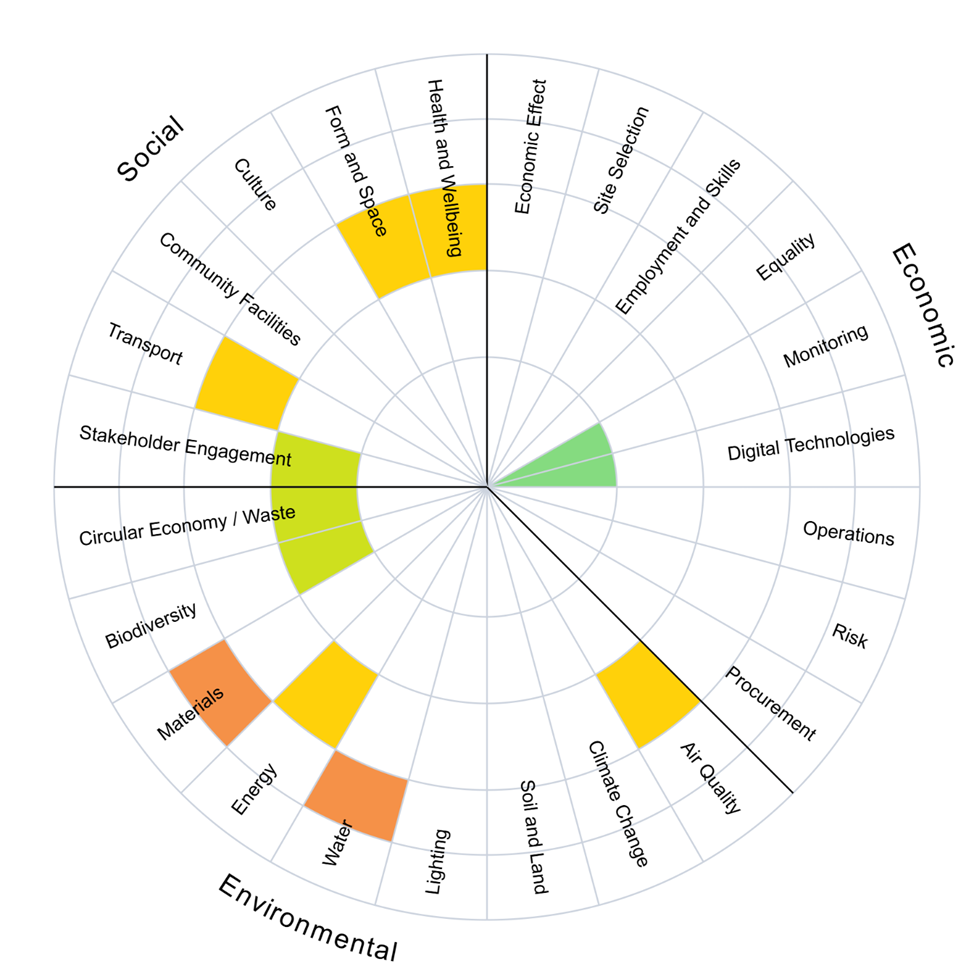
Fig 08. - The SPeAR tool evaluates a project’s sustainability by visually mapping its performance across 24 indicators Source: ARUP, 2025
In considering an approach for project assessments from the evaluation of existing tools, several criteria for EMI projects emerge:
- Limit complexity by focusing on factors with maximum impact across typical EMI project types and locations, yet holistically assessed across integrated dimensions.
- Reduce barriers to use and training requirements, e.g. professional credentials like LEED AP.
- Reduce cost (and time investment) to EMI and our partners by avoiding formal certification programmes or third-party reviews.
- Derive a framework that allows for regional benchmarking and local adaptation, yet maintains broad applicability from a common standard applied across EMI regions.
- Develop a tool (or an existing tool for use within EMI) that guides the design process from inception through the design stages into construction and post-construction.
- Move beyond targets aimed at “doing less harm” within a resource-consuming paradigm to actively improving ecosystems through restorative and regenerative responses.
Like the DRR example noted previously, mainstreaming sustainability measures at some level across all standard projects in addition to specialised services for select projects increases overall impact and reinforces a commitment to creation care across all EMI interventions.
Unifying Statement:
Supporting a unified, consistent response to improving sustainability across EMI projects requires standardised guidance, assessment tools and training for project teams, while allowing for individual project baselining and local adaptation.
4.3 Project Metrics
We gain a greater awareness of the impact of our engagement in creation care by including sustainability goals within our core value metrics - tracked, evaluated and shared EMI-wide through a Design Dashboard.
Project ‘process’ Outputs, leading to Outcomes resulting in ‘Stories of Impact’ may include similar factors or indicators as mentioned in 4.1. Success is measured by adherence to standard principles (not a standard design expression) within each indicator as applied to the design and construction approach for a project.
Verification may occur through abbreviated post-project surveys completed by the EMI project manager. In the DRR mainstreaming example, this may be a simple Y/N response on whether the DRR process was followed/ completed. If Disaster Resiliency was identified as a sub-indicator within the environmental dimension of an assessment tool and locally baselined, the survey may ask whether the benchmarking target was achieved within the design response.
The relational and theological dimensions of restoration within EMI projects are further emphasised in how we build project teams and through our Diversity and Discipleship core values, also measured through our CV metrics.
Unifying Statement:
By embedding sustainability goals and creation care principles into EMI’s core value metrics, we cultivate a consistent and measurable project approach while encouraging a restorative design and construction process.
4.4 Conclusion
As a ministry established in the work of design and construction, EMI operates at the intersection of people, place, and purpose. We see first-hand how the natural environment affects lives, livelihoods, and the built environment. Our commitment to serve communities and the church compels us to pay attention to these realities—not merely as technical challenges, but as deeply spiritual and missional concerns. We recognise that Creation Care is not an optional add-on to our work, but an essential act of love for our neighbours, a faithful response to God’s gifts, and an active sharing in His work of restoration. This commitment stands regardless of shifting cultural narratives or scientific debates, because it is grounded in God’s unchanging call to steward His creation faithfully.
In practice, we express this commitment through a built response that aligns with the character and purpose of our mission- holistically engaging with the needs of those we desire to reach. This work can be supported by tools, training, and standardised guidance that allow for both consistency across project regions and adaptation through unique expression in the local context. By integrating sustainability goals into our operations, our projects and our core value metrics, we develop a focus for excellence in our work, resulting in measurable impact through our teams, our partners and the communities we serve together.
Download the Full Whitepaper:
Related articles


Your investment in EMI is a catalyst for change.
Community transformation starts with design. And design needs a strong foundation. Your donation to the EMI Fund supports everything we do.
EMI Tech is looking for contributors – write to publications@emiworld.org with your topic and article outline.